ART.PE: booth G2

Zipper Galeria takes part in ART.PE — Feira de Arte Contemporânea de Pernambuco for the first time, from 14 to 18 October 2026, at Recife Expo Center. At booth G2, the gallery presents a selection of works by the artists it represents. Some of them were made in Pernambuco or start from images of the state.
In 2021, Flávia Junqueira photographed three historic buildings in the region: the Theatro de Santa Isabel and the Cinema São Luiz, in Recife, and the Mosteiro de São Bento, in Olinda. The artist fills these spaces with balloons and photographs the scene. At the Santa Isabel, balloons tied to strings take over the stalls and balconies beneath the central chandelier. The images are part of Flávia's journey through Brazil's historic theatres, which also includes the Theatro São Pedro and the Theatro Municipal do Rio de Janeiro.
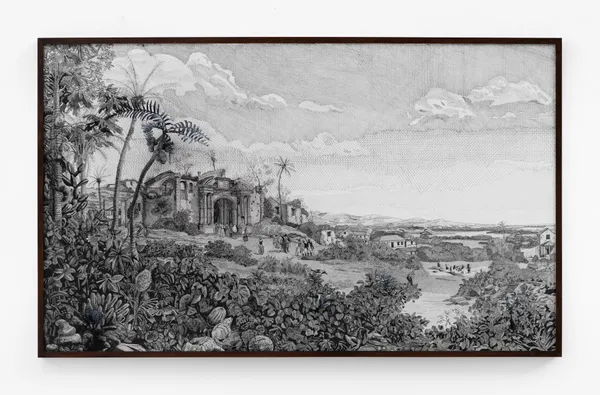
Camille Kachani presents D’après Frans Post: vista de Olinda (2026). The Dutch painter Frans Post arrived in Brazil in 1637 and was still painting Olinda in 1662. Kachani remakes one of these views by hand, in India ink and graphite on paper: the ruined church, the figures on the path and the river in the distance sit behind vegetation that fills the foreground. The work continues the research of his solo show Uma contra-história do Brasil (Zipper Galeria, 2025), in which the artist rereads the country's official history from the standpoint of the peoples it silenced.
Rodrigo Braga was born in Manaus, grew up in Recife and graduated in Fine Arts from UFPE in 2002. He describes himself as a “farmer photographer”: each image begins as a drawing and is built on site, with earth, water, charcoal and his own body, without digital post-processing. At ART.PE, he shows bandeirolas (small banners), a standard and the Equilíbrio aparente pieces from the Ponto Zero series: paintings in charcoal, mineral pigment and acrylic on cotton canvas, held to the wall by cast brass rods, as in his solo show Um presente para o futuro (Zipper Galeria, 2026). The photographs Aurora (2024) and Presságio (Fulgor #01) (2025) complete the group.
Janaina Mello Landini works with thread as structure. An architect by training, in 2010 she coined the neologism "ciclotrama" to name a research that brings together structural mathematics and philosophy to consider how the unit relates to the whole in network systems. A rope is unravelled into minimal filaments, which open across the canvas according to algorithms and to the forces of matter: weight, torsion, traction, time. Irregularities are not corrected; they become part of the work.
In the artist's reading, each Ciclotrama is a metaphor for a flow that turns into volume, as in the deltas of a river basin, where what is hidden is not absence but accumulation. In Ciclotrama 420 (superstrato), a 150 x 150 cm diptych, the braided rope crosses the junction of the two canvases and opens into filaments on both sides. In Ciclotrama 407 (fungi), threads of different colours and thicknesses overlap in layers on linen. Both are from 2026, the year of Acorda, the artist's sixth solo show at Zipper, and of the Iris van Herpen retrospective at the Brooklyn Museum, in which she also takes part.
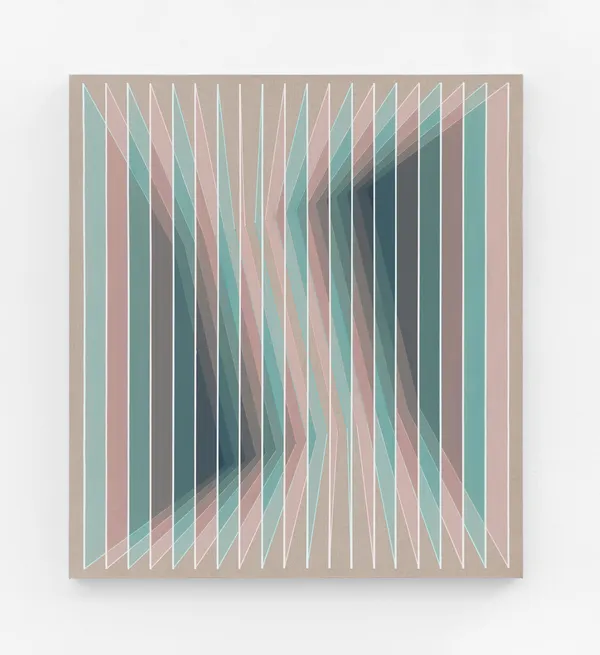
Daniel Mullen, a Scot based in Rotterdam, paints in glazes, a technique he learned at a Rudolf Steiner school: thin, translucent layers of acrylic on raw linen, often with only the three primary colours. Each layer changes the colour of the one beneath it. In the Proximity series, vertical bands repeat from one edge to the other; with each pass the pattern shifts, and the surface seems to fold into depth at the centre of the canvas.
From a distance, the paintings look computer-made; up close, they reveal the hand and the linen between the bands. The research draws on the colour studies of Josef Albers and Johannes Itten and on an observation by Henri Matisse that gave its title to the artist's solo show at Zipper in 2025, Nothing in Isolation: no colour exists on its own, and meaning lies in the relationship.
Ivan Grilo builds his work on literature. The phrases he writes are cast in bronze, a metal associated with monuments and permanence, to keep what is transient: gestures, waits, small rituals. Many texts have the tone of a mantra and are only complete when someone reads them aloud, and whoever reads becomes the speaker of the work.
Trecho de luz entre dois milagres (2024) is a narrow plaque, 13 x 50 cm, with the title in relief on a single line. Novos bálsamos sagrados (dividir, desfrutar, agradecer) (2026) lists fourteen actions in the infinitive, such as "to look into the eyes", "to understand oneself as fragile" and "to ask the mystery for help", and the subtitle repeats the three verbs that close the list. His works are in collections such as MoMA and MASP.
Giovani Caramello sculpts ordinary people at altered scale. The process begins with a drawing, based on images from the internet or on people close to him. Then comes 3D modelling, printing at final size and layers of plasticine that build skin, folds and anatomy. Only then is the figure moulded, cast in resin and painted by hand.
His hyperrealism does not seek complete illusion: the proportions depart from the natural body, and the polychrome resin brings the figures close to a three-dimensional illustration. With no setting and no other characters, the narrative lies in posture and face. In Sem título (Untitled, 2026), a boy with a backpack, white T-shirt and denim shorts stands still, arms by his sides, 60 cm tall. The theme running through the research is impermanence: lived time, solitude, fragility in the face of the years.
-
 Camille KachaniD'après Frans Post: vista de Olinda, 2026Técnica mista sobre papel, nanquim e grafite105 x 173 cm
 -
Camille KachaniD’après Frans Post, Dia de Festa no engenho, 2019Técnica mista57 x 60 x 22 cm
-
Daniel MullenProximity extention nº3, 2026Acrílica sobre linho130 x 120 cm
-
Daniel MullenProximity extention nº1, 2026Acrílica sobre linho130 x 120 cm
-
Daniel MullenProximity VII: pink-tourqoise shift, 2025Acrílica sobre linho100 x 90 cm
-
Flávia JunqueiraCinema São Luiz #1, 1952, Recife, 2021Pigmento mineral sobre papel de algodão150 x 203 cm
-
Flávia JunqueiraMosteiro de São Bento #1, 1599, Olinda, 2021Pigmento mineral sobre papel de algodão130 x 215 cm
-
Flávia JunqueiraTheatro de Santa Isabel, 1841 #1, Recife, 2021Pigmento mineral sobre papel de algodão150 x 190 cm
-
Flávia JunqueiraTheatro de Santa Isabel, 1841 #2, Recife, 2021Pigmento mineral sobre papel de algodão150 x 210 cm
-
Giovani CaramelloSem título, 2026Resina e tinta acrílica60 x 28 x 28 cm
-
Ivan GriloTrecho de luz entre dois milagres, 2024Bronze13 x 50 cm
-
Ivan GriloNovos bálsamos sagrados (dividir, desfrutar, agradecer), 2026Bronze30 x 21 cm
-
Ivan GriloVoilà mon coeur, 2026Bronze21 x 30 cm
-
Janaina Mello LandiniCiclotrama 407 (Fungi), 2026Fios variados sobre linho95 x 62 cm
-
Janaina Mello LandiniCiclotrama 420 (superstrato), 2026Fios variados sobre linho150 x 150 cm (díptico)
-
Rodrigo BragaPresságio (Fulgor #01), 2025Pigmento mineral sobre papel de algodão90 x 60 cm
-
Rodrigo BragaAurora (da série Ponto zero), 2024Pigmento mineral sobre papel de algodão120 x 80 cm
-
Rodrigo BragaBandeirola #24 (da série Ponto zero), 2026Carvão, pigmento mineral e acrílica sobre lona de algodão e hastes fundidas em latão37 x 44 cm
-
Rodrigo BragaBandeirola #19 (da série Ponto zero), 2026Carvão, pigmento mineral e acrílica sobre lona de algodão e hastes fundidas em latão44 x 50 cm
-
Rodrigo BragaBandeirola #18 (da série Ponto zero), 2026Carvão, pigmento mineral e acrílica sobre lona de algodão e hastes fundidas em latão26 x 38 cm
-
Rodrigo BragaBandeirola #20 (da série Ponto zero), 2026Carvão, pigmento mineral e acrílica sobre lona de algodão e hastes fundidas em latão36 x 49 cm
-
Rodrigo BragaBandeirola #22 (da série Ponto zero), 2026Carvão, pigmento mineral e acrílica sobre lona de algodão e hastes fundidas em latão52 x 47 cm
-
Rodrigo BragaBandeirola #26 (da série Ponto zero), 2026Carvão, pigmento mineral e acrílica sobre lona de algodão e hastes fundidas em latão63 x 50 cm
-
Rodrigo BragaBandeirola #25 (da série Ponto zero), 2026Carvão, pigmento mineral e acrílica sobre lona de algodão e hastes fundidas em latão68 x 50 cm
-
Rodrigo BragaBandeirola #27 (da série Ponto zero), 2026Carvão, pigmento mineral e acrílica sobre lona de algodão e hastes fundidas em latão63 x 73 cm
-
Rodrigo BragaBandeirola #23 (da série Ponto zero), 2026Carvão, pigmento mineral e acrílica sobre lona de algodão e hastes fundidas em latão52 x 50 cm
-
Rodrigo BragaBandeirola #28 (da série Ponto zero), 2026Carvão, pigmento mineral e acrílica sobre lona de algodão e hastes fundidas em latão36 x 52 cm
-
Rodrigo BragaBandeirola #29 (da série Ponto zero), 2026Carvão, pigmento mineral e acrílica sobre lona de algodão e hastes fundidas em latão52 x 50 cm
-
Rodrigo BragaEquilíbrio aparente / Galhos (da série Ponto zero), 2026Carvão, pigmento mineral e acrílica sobre lona de algodão e hastes fundidas em latão50 x 82 cm
-
Rodrigo BragaEquilíbrio aparente / Ovos (da série Ponto zero), 2026Carvão, pigmento mineral e acrílica sobre lona de algodão e hastes fundidas em latão50 x 82 cm
-
Rodrigo BragaEstandarte #1 (da série Ponto zero), 2026Carvão, pigmento mineral e acrílica sobre linho de algodão e hastes fundidas em latão110 x 70 cm